Last updated: April 2026
Grand Chateau Kyobashi Quick Facts
- Address: 2-1-26 Higashinodamachi, Miyakojima-ku (30 sec from JR Kyobashi Station, south exit)
- Price: ¥900–¥1,800 (sauna floor, cash recommended)
- Hours: Sauna floor varies; the building itself runs day-to-late-night
- Tattoo: No published policy — call ahead, may be refused at door
- English: Effectively none — Japanese-only signage and staff
- Gender: Men only (sauna floor 5F); women can use other building floors
- Best for: Repeat Osaka visitors seeking authentic Showa-era texture
- Website: kyo-bashi.com
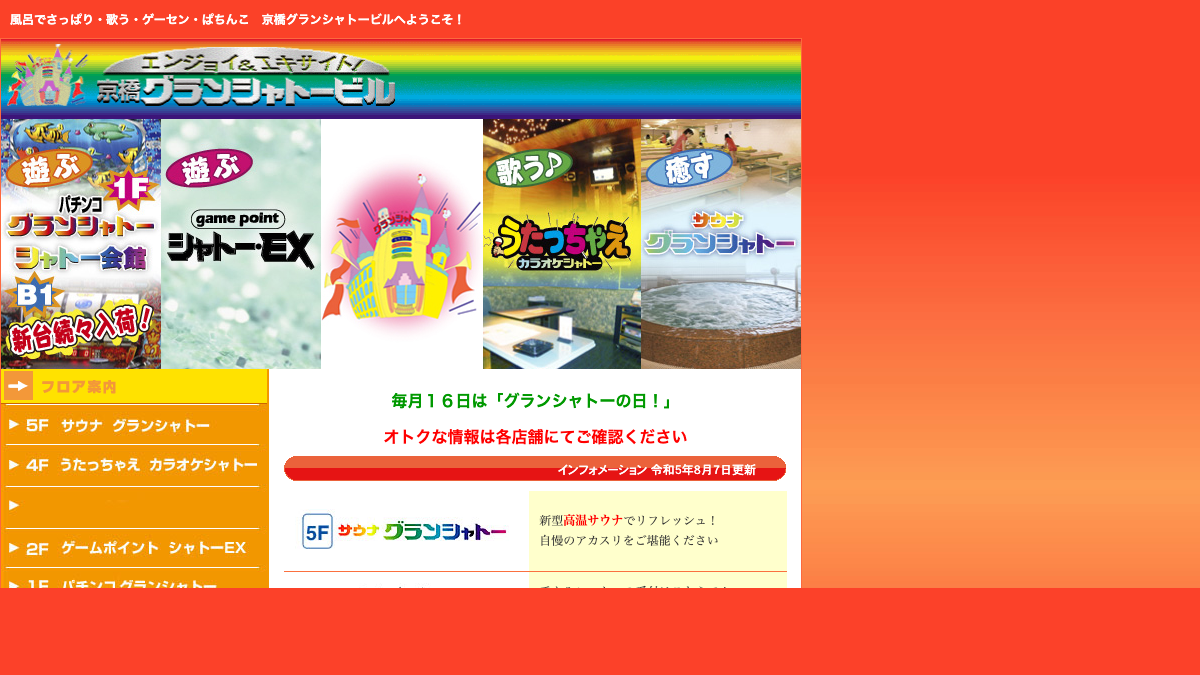
There is a building at the eastern edge of central Osaka, directly next to Kyobashi (京橋) Station, that does not appear in any guidebook written in English. It is not beautiful. It does not photograph well. Google Maps reviews from Japanese visitors describe it with a specific kind of affection that is hard to translate: something between "deeply local" and "if you know, you know." The building is called Grand Chateau (グランシャトー), its official website is still alive at kyo-bashi.com, and it houses one of the last honest-to-god Showa-era entertainment complexes left standing in a major Japanese city. The building has been running since November 1971 — more than fifty years now. Inside: a cabaret, a theater, multiple restaurant floors, game arcades, and—tucked away on one of the mid-levels—a men's sauna and bathhouse floor where the regulars have been regulars since Reagan was president.
This is not a sauna we would send a first-time Japan traveler to if they were looking for the polish of DESSE or the spectacle of Spa World. But it is the single most Osaka-feeling sauna experience in the city, and for the kind of foreign visitor who has already done the obvious tourist circuit and started exploring Osaka's quieter backstreets, Grand Chateau is the next logical pilgrimage — a cultural artifact that Tokyo long ago bulldozed and redeveloped out of existence. This guide walks through the building, its legendary jingle, what the sauna is actually like, how to visit as a foreigner without either embarrassing yourself or missing the point, and why locals still talk about this place the way they do.
"Kyobashi wa Ee Toko Dasse" — The Jingle That Defined Osaka
Before we get to the sauna, we need to explain the song. If you live in Japan for any length of time, you will eventually hear someone of a certain age break into a cheerful, high-pitched chant:
Kyobashi wa ee toko dasse,
Grand Chateau ga omasse.
(Kyobashi is a great place, and Grand Chateau's there!)
This is the Grand Chateau Kyobashi commercial jingle, and it has been running on local Osaka TV and radio since 1971 — the year the building opened. That is more than fifty years. There are salarymen in Osaka who cannot remember their own grandmother's birthday but can reliably belt out this jingle, in key, after three beers. It is a cultural touchstone so deeply embedded in Kansai identity that it functions as a shibboleth—if you can finish the line when someone starts it, you're family.
Understanding the jingle is how you understand Grand Chateau. The building exists in a specific cultural register: working-class Osaka entertainment, cheerful and unpretentious, slightly adult, fundamentally warm. It is not trying to be chic. It has never once been chic. It has been profitable, popular, and beloved for six decades, and that is a different and more interesting thing than chic.
What's Inside the Tower
Grand Chateau is a multi-floor entertainment complex, and its charm is that each floor is a different kind of old-school Japanese nightlife venue. Here's a foreigner's-eye view of which floors to engage with:
- Cabaret & theater — What's there: Showa-era costumed shows, dinner service · Visitable for foreigners?: Yes — anthropologically fascinating · Notes: Kitsch, nostalgic, large-stage
- Restaurants — What's there: Kushikatsu, teishoku, ramen, fusion · Visitable for foreigners?: Yes — reasonable prices · Notes: Working-class Osaka staples
- Sauna & bathhouse (5F) — What's there: Old-school men's sauna, bath, rest zone · Visitable for foreigners?: Yes — men only · Notes: The reason this article exists
- Game arcades — What's there: Pachinko, slots, vintage games · Visitable for foreigners?: Yes — fun to walk through · Notes: Often full of afternoon regulars
- Associated services — What's there: Adult-clientele services · Visitable for foreigners?: Not your concern · Notes: Operates independently from sauna
The cabaret shows lean kitsch and nostalgic, and whether you find them fascinating or baffling is entirely a question of whether you enjoy cultural artifacts for their own sake. The sauna floor is clearly marked, straightforward, and operates independently from the rest of the building's offerings.
The Sauna Experience
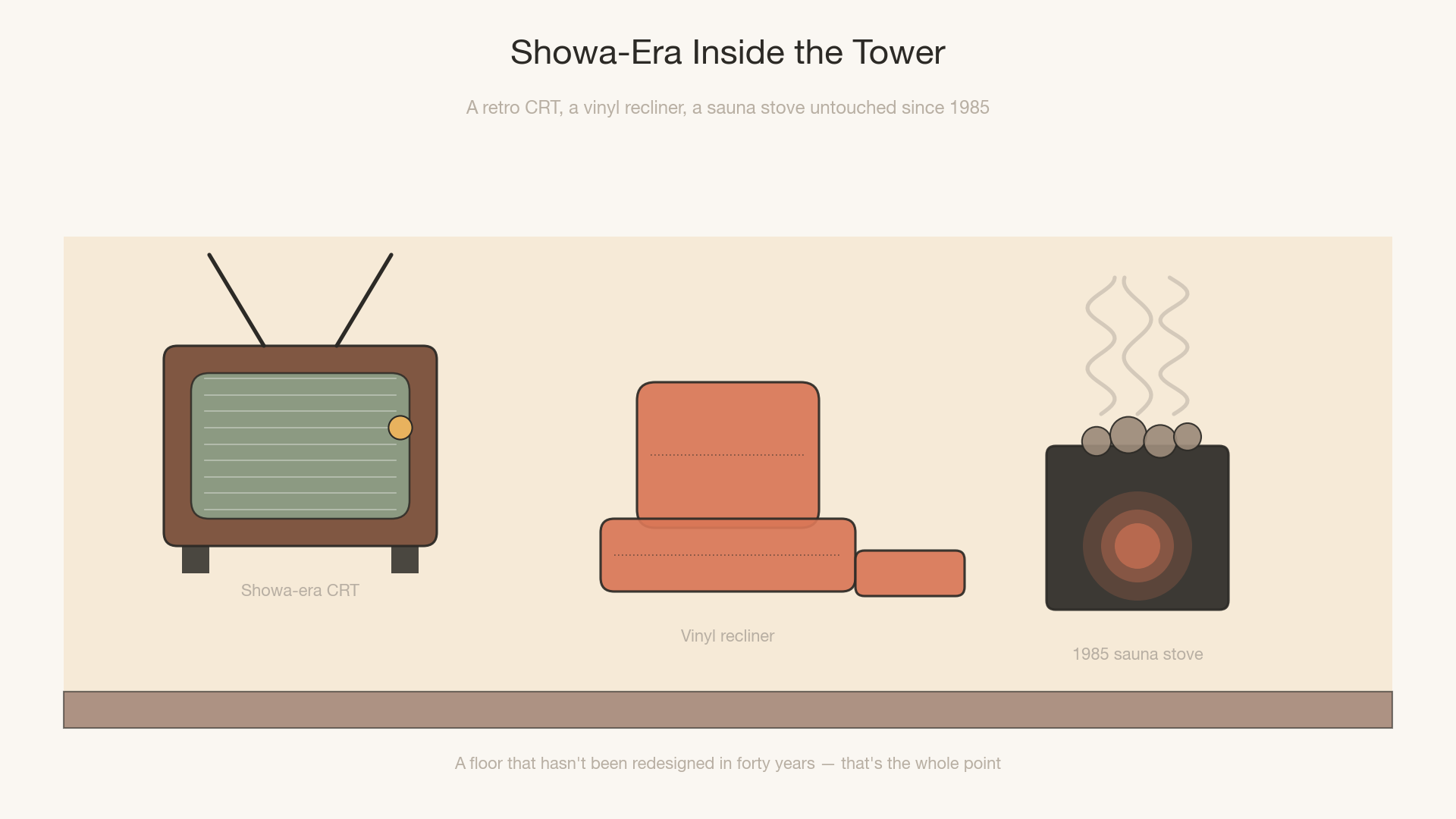
Let's set expectations. The sauna at Grand Chateau is not going to compete with DESSE on craft, with Spa World on scale, or with Solaniwa on scenery. What it offers is texture. A genuine, unrenovated, Showa-era men's sauna where the wood has that particular dark honey patina that only comes from thirty years of sweating bodies and daily wipe-downs. A small-to-medium sauna room running at what feels like a very traditional 90°C. A cold bath that has probably been at exactly the same temperature since 1998. A rest area with vinyl-upholstered recliners and a dated but functioning TV in the corner playing baseball. This is a sauna as a time machine.
The regulars are the experience. At any given hour—morning, afternoon, late evening—you will find a rotation of men in their fifties, sixties, and seventies for whom this floor is a second living room. They know the attendant's name. They know each other's names. They have an established set of routines, jokes, and rituals. They will not speak English. They will also almost entirely ignore you if you follow the rules and don't do anything weird, which, for a foreign visitor who just wants to observe and participate respectfully, is a kind of inclusion more meaningful than being greeted in English at a reception desk.
The flow is the same as any Japanese sauna: shower thoroughly, enter the sauna, exit, rinse, cold bath, rest. There are fewer amenities than a premium sauna—bring your own toothbrush if you care, the towels are basic, and you might want to bring your own small travel shampoo if you're particular. But the fundamentals all work. Water is hot. Cold is cold. The rest area is comfortable. A round of three sets here costs about one-quarter of a round at DESSE.
Beyond the Sauna: The Kyobashi Neighborhood
Grand Chateau sits in Kyobashi, which is one of Osaka's great underexplored neighborhoods and a reason in itself to make this trip. Kyobashi is a working-class district—home to generations of Osaka office workers who commute from the suburbs into this station and stop for a drink on the way home. The streets around the station are dense with standing bars (tachinomi), izakayas, yakitori joints, small ramen counters, and shops selling discount alcohol. The atmosphere is loud, cheerful, slightly disorderly, and completely free of the tourist-polish of Dotonbori.
A perfect Kyobashi evening goes like this: arrive around 5 PM. Start with a beer and three skewers at a tachinomi outside the station—budget ¥1,200 for the whole stop. Wander. Eat takoyaki from a street cart. Have a second beer at a different standing bar. Around 7:30 PM, walk over to Grand Chateau and do a 90-minute sauna session. Emerge around 9 PM with the specific glow that sauna-plus-two-beers produces in a way nothing else does. Walk back to the Kyobashi streets and eat a proper dinner—yakitori, horumon (grilled offal), ramen. Catch the last train home. This is Osaka. This is what it actually is.
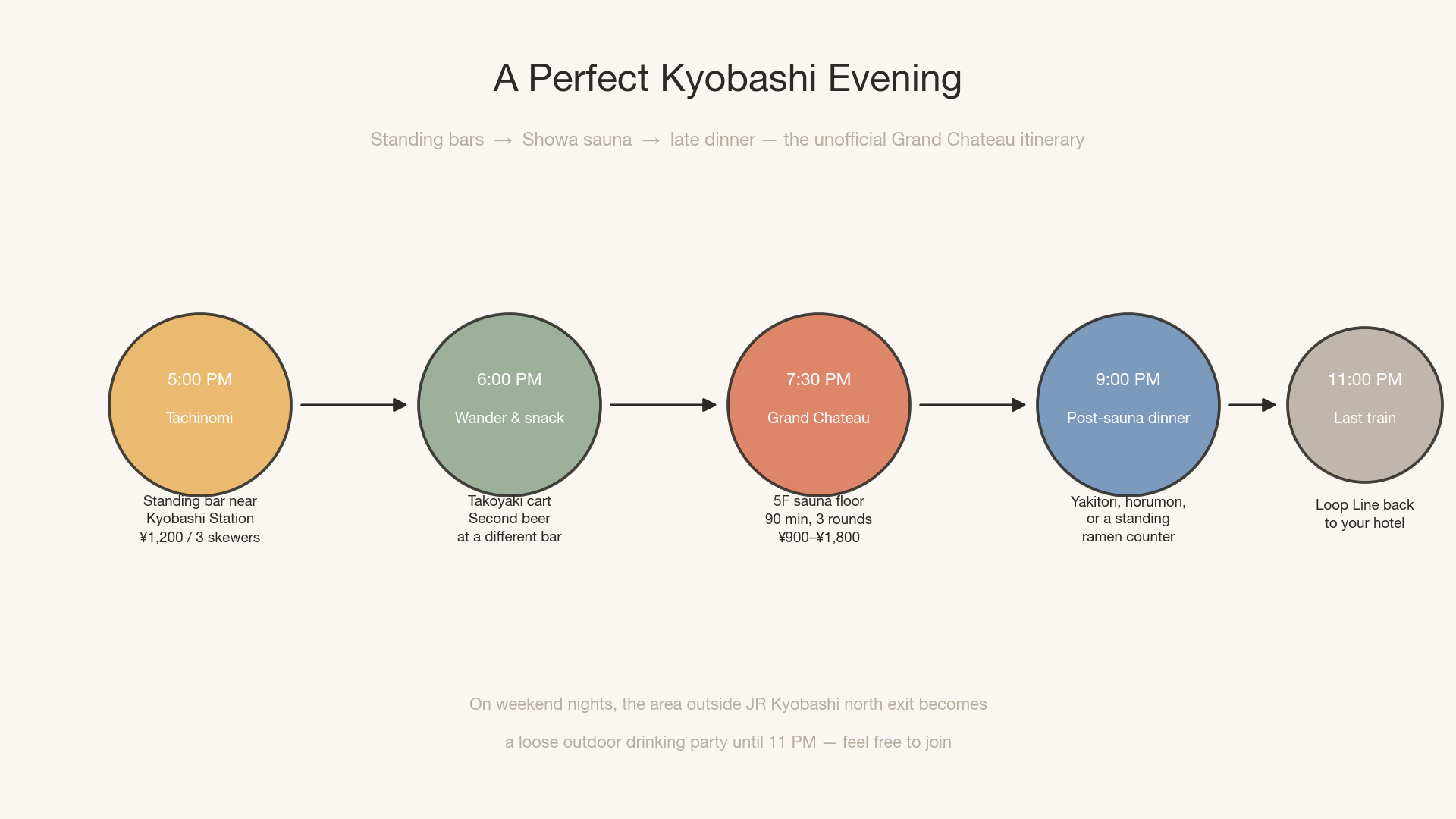
If you are in Kyobashi on a weekend evening, the area around the JR Kyobashi Station north exit turns into a loose outdoor drinking party until about 11 PM, with salarymen sitting on benches with convenience-store highballs and occasionally breaking into song. You are welcome to join.
How to Visit as a Foreigner
Access. Grand Chateau is about 30 seconds' walk from JR Kyobashi Station's south exit. Kyobashi is on the JR Osaka Loop Line, so it's about 5 minutes from Osaka Station and 8 minutes from Tennoji. It's also served by the Keihan Main Line (for connections to Kyoto) and Osaka Metro Nagahori-Tsurumi-ryokuchi Line. Very easy to reach from anywhere in the city.
Pricing. The sauna floor runs roughly ¥900–¥1,800 depending on the time of day and any package options. Cash is the safe bet. Bring a few ¥1,000 notes.
Tattoos. Grand Chateau does not publish a formal tattoo policy on its website or in major sauna directories — the field is left blank on every Japanese sauna reference site we checked. In practice, the door policy is at the desk's discretion, and as with most Showa-era sento and small bathhouses, the safest assumption is that visible tattoos may result in being turned away. If you have tattoos and want to attempt a visit, call ahead or stop by the desk before you change. Skin-colored tattoo cover stickers (available at Don Quijote) help for small-to-medium marks, but they are not guaranteed to be accepted. If you have extensive tattoos, a private-suite facility like KUDOCHI Shinsaibashi is the more reliable path, and our list of openly tattoo-friendly onsen in Osaka covers smaller bathhouses with explicit entry rules. Please be advised that an unconfirmed visit to Grand Chateau may result in entry refusal.
English. Effectively none. The signage is Japanese, the staff speak Japanese, and the regulars speak Japanese. The actions required (take off shoes, get locker key, shower, sauna, rest) are universal, and the environment is forgiving to foreigners who are clearly trying to do the right thing. A translation app on your phone handles any reception-desk communication that goes beyond pointing and a small bow.
Dress and etiquette. Walk in as you normally would. In the sauna and bath, you are fully naked following standard Japanese bathing rules. Shoes come off at the building entry or the bathhouse floor entry—look for the shoe lockers. Phones stay in the locker.
Best time to go. Weekday evenings from 6 PM to 9 PM is when the regular character of the place is fullest. Weekday mid-afternoons are quieter if you want a gentler first visit. Saturday nights are busy and fun but noisier.
Pro Tip: Don't show up expecting a premium spa day and be disappointed; show up expecting a time machine and be delighted. The experience is not the sauna—the experience is being in a building that still operates exactly the way it operated in 1985, in a city that has quietly decided this is worth preserving. Cap the night with a late-night bowl of ramen at one of the standing shops behind Kyobashi Station and you've covered the full arc of working-class Osaka in a single evening.
Website: http://www.kyo-bashi.com/
FAQ: Grand Chateau Questions From Foreign Visitors
Is Grand Chateau safe for foreign visitors? Yes. Kyobashi is a working-class entertainment neighborhood, not a red-light district. The streets are well-lit, the regulars are friendly, and the building itself is well-run. Standard Japanese urban safety applies—which is to say, very safe.
Can women visit Grand Chateau? Women can absolutely visit the building itself and eat at the restaurants, see the theater shows, and watch the cabaret. The sauna floor discussed in this guide is men-only. For women looking for an Osaka sauna, our top picks are DESSE Shinsaibashi (women's floor in the public area, plus the mixed-gender Knot Sauna on Tattoo Days) and KUDOCHI Shinsaibashi (fully private suites for couples or solo). Spa World and Solaniwa Onsen also have women's floors, but their tattoo policies are restrictive — see our full Osaka Sauna Guide for the facility-by-facility breakdown.
Is this a tourist trap? No. That's the point. Grand Chateau barely acknowledges tourists. Its core business has been regular locals for fifty-plus years. A foreign visitor here is a curiosity, not a target market.
Do I need to reserve? No reservations for the sauna floor. Walk-in.
What should I not do? Don't take photos (this is enforced). Don't try to speak loudly in English with friends in the sauna room. Don't bring a group of more than two—this is a small, quiet environment and a loud foreign group would be disruptive. Don't wear a swimsuit. That's it.
Where do I go after? Eat. Kyobashi's street food and standing bars are right outside the door. A post-sauna beer and three yakitori skewers on a standing bar counter is one of the definitional Osaka experiences and the correct way to end a Grand Chateau visit.
How Grand Chateau Compares to Osaka's Other Major Saunas
Grand Chateau exists at the opposite end of the spectrum from polished premium saunas. The table below maps where it sits in the city's bath landscape:
- [DESSE (Shinsaibashi)](/articles/desse-sauna-osaka/) — Vibe: Premium, design-driven · Price: ¥3,500–¥4,500 · Tattoo: Conditional (Knot Sauna, Tattoo Days) · Best for: Sauna craft enthusiasts, polished first-timer
- [Spa World (Shinsekai)](/articles/spa-world-osaka-guide/) — Vibe: Populist, world-tour theme park · Price: ¥1,500–¥2,700 · Tattoo: Not allowed (any size, even stickers) · Best for: Families, budget travelers without tattoos
- [Solaniwa Onsen (Bay Area)](/articles/solaniwa-onsen-osaka/) — Vibe: Edo-themed garden, scenic · Price: ¥2,500–¥3,400 · Tattoo: Conditional (facility's stickers required) · Best for: Couples, USJ / Kaiyukan day-trip pairing
- Grand Chateau (Kyobashi) — *you are here* — Vibe: Showa retro, men-only · Price: ¥900–¥1,800 · Tattoo: No published policy — call ahead · Best for: Repeat visitors chasing authentic texture
For the full lineup including private-suite and neighborhood-sento options, see our Osaka Sauna Guide for Foreigners.
Final Thoughts: The Building That Refuses to Change
There is a specific kind of travel memory that only happens when you step into a place that should not still exist by the normal rules of urban development. Most major cities have redeveloped their mid-century entertainment complexes into something shinier. Tokyo did it. Yokohama did it. Nagoya did it. Osaka mostly did it—and then, on a corner in Kyobashi, decided one tower would just be left alone. Grand Chateau is that tower.
If you are a foreigner visiting Osaka for the first time and you have one night to spare from the obvious tourist circuit, you can spend it at Dotonbori for the neon, at Shinsekai for the kushikatsu, or at Kyobashi for Grand Chateau and the streets around it. All three are valid. But only one of them gives you something you will never be able to find again if Grand Chateau finally closes: a complete, operating, unrenovated slice of the Osaka that your Japanese friends' parents grew up in.
Walk in, sweat for an hour, walk out, drink a beer on the street while someone nearby starts humming the jingle. That's the trip.
Compare Grand Chateau with the rest of the city's sauna scene in our full Osaka Sauna Guide for Foreigners. For the complete post-sauna street-food and standing-bar landscape, our Osaka Nightlife Guide covers every Kansai drinking neighborhood worth knowing.