Last updated: April 2026
DESSE Sauna Shinsaibashi Quick Facts
- Address: 3-6-18 Minamisenba, Chuo-ku, Osaka — Kei's Building 4F (3 min from Shinsaibashi Station, Midosuji Line)
- Price: ¥3,500–¥4,500 (120 min slot); Knot Sauna private rental ¥20,000 / 120 min for 1–6 people
- Hours: 11:00 – 9:00 next morning (varies by day; check official site)
- Tattoo: Conditional — public floors OK on Wed–Sat; Knot Sauna private suite OK any day
- English: Basic staff English; English website
- Best for: Sauna enthusiasts, couples, design-conscious first-timers
- Booking: Online reservation required
- Website: desse.osaka
Tucked into a quietly impressive multi-floor building a short walk from the Shinsaibashi (心斎橋) shopping district and its main subway station, DESSE is the sauna that finally put Osaka on the national saunnor map. Before DESSE, serious Japanese sauna enthusiasts in Kansai would compare notes on trips up to Tokyo—to SaunaLab, to Kanon Sauna, to the Dormy Inn circuit. Since DESSE opened, the conversation has inverted. You now hear Tokyo enthusiasts explain why they're making a day trip down the Shinkansen just to do a proper session here.
If you are a foreigner in Osaka and you only have time for one premium sauna experience on your trip, this is the one we would send you to. It is the most polished introduction to what modern Japanese sauna culture can actually feel like when it is designed with care: a proper Finnish löyly room, a cold bath at the exact temperature that works, a lounge you actually want to hang out in, and staff who have thought hard about what the non-Japanese guest might stumble over. This review walks through what it's like inside, what it costs, how to book, what to wear (and not wear), how the tattoo policy works, and how to combine DESSE with the rest of your day in Shinsaibashi.
What Makes DESSE Different
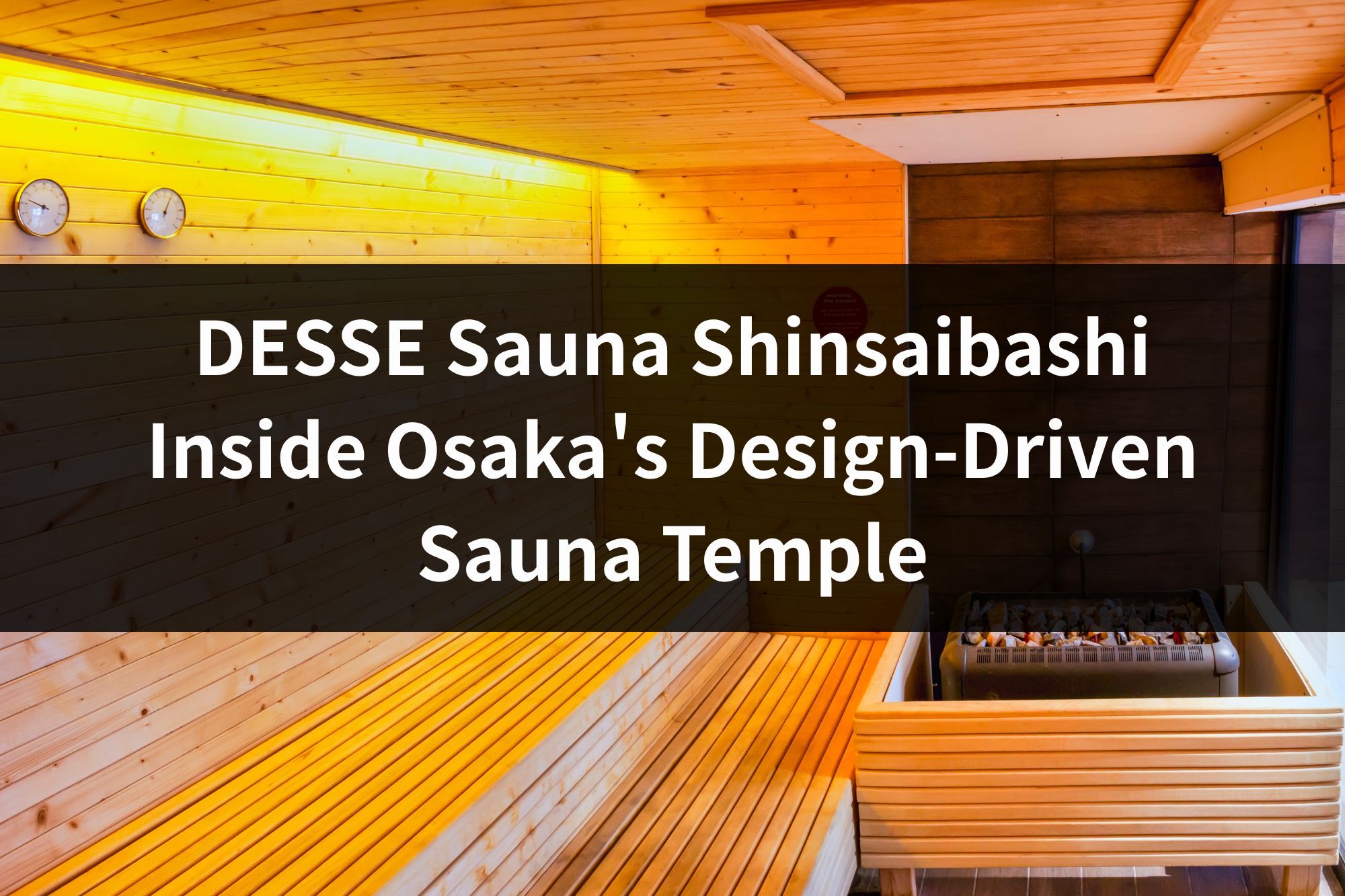
DESSE sits at the intersection of two things that rarely appear in the same Japanese bathing facility: genuine sauna craft and genuine interior design. Most super sento in Japan have functional but aesthetically indifferent sauna rooms—a box with a stove, fluorescent lighting, a Showa-era temperature gauge. Most boutique spas, on the other hand, look beautiful but treat sauna as an afterthought next to massage and facials. DESSE does both. The sauna rooms are built to the specifications of Finnish purists—properly proportioned benches, stones that actually glow, ladles and water buckets that are in constant use—and the space around them is designed with the kind of restraint you'd expect from a Daikanyama boutique hotel.
The facility is split by gender for the actual bathing floors, with separate men's and women's sauna, cold bath, and air-bath areas on different floors. But DESSE also pioneered something that traditional Osaka bathing simply didn't have: a mixed-gender lounge where you reunite with your group wearing facility-provided sauna wear between sets. You sit on low-slung wooden benches, drink a cold craft beer or a house-blend kombucha, talk quietly, and then split up again to go back to your respective gendered floors. For foreign couples and mixed groups, this design choice is genuinely life-changing compared to the standard Japanese onsen split where you say goodbye at the shoe lockers and don't see each other again for two hours.
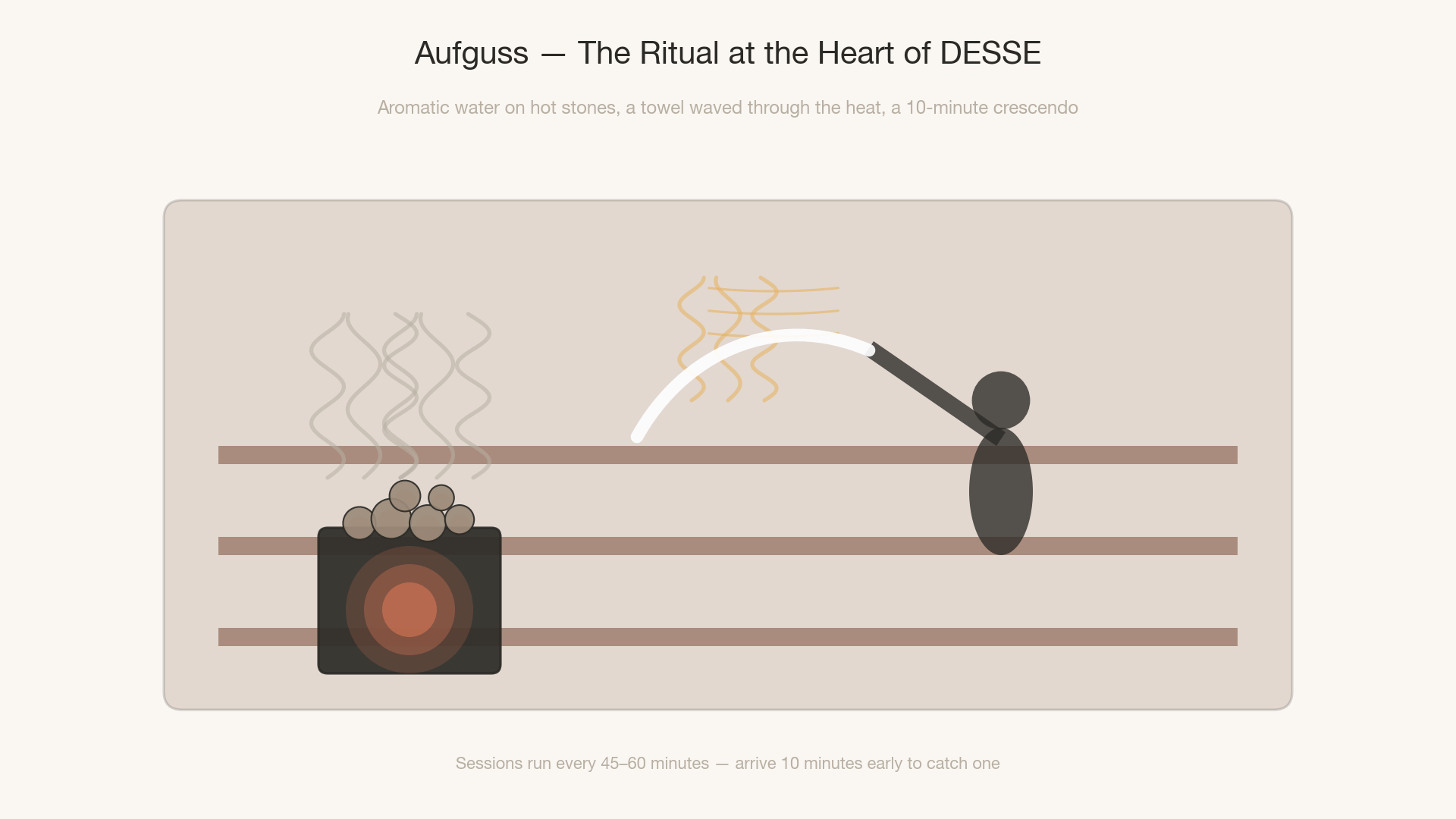
The ritual itself runs on scheduled aufguss sessions—a staff member pours aromatic water on the stones, waves a towel to distribute the heat, and guides the room through a 10-minute burst of intense, fragrant steam. These sessions are announced on the board and usually run every 45–60 minutes. Arriving 10 minutes before a scheduled aufguss is the single best move a first-time DESSE visitor can make.
The Sauna Rooms and Water Bath
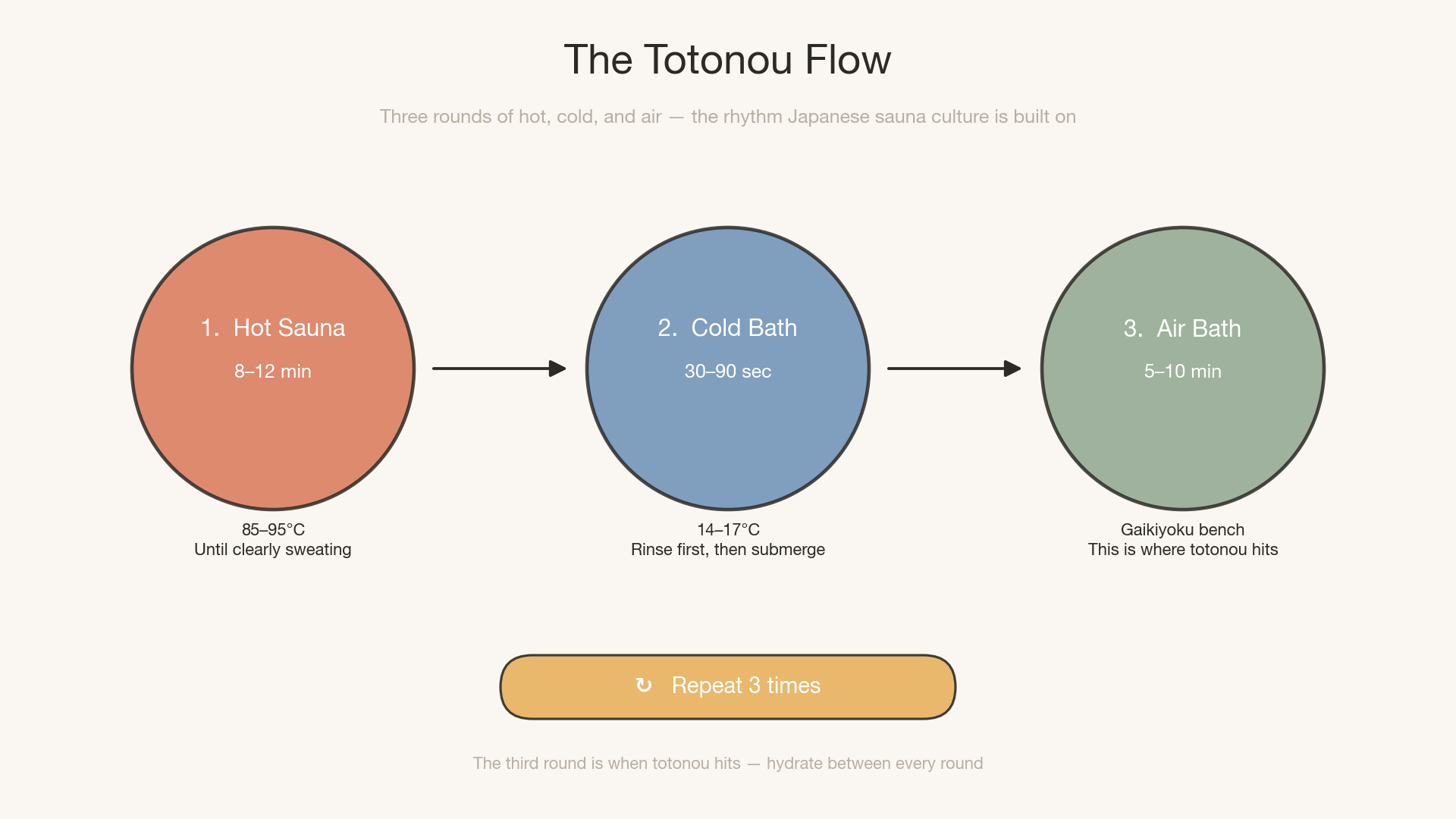
The main sauna room on each gender floor runs at roughly 85–95°C depending on the hour. Three-tier bench structure, good air circulation, and a proper Finnish stove with a clear line of sight from every seat. The upper bench is noticeably hotter than the lower one; pace yourself on your first round.
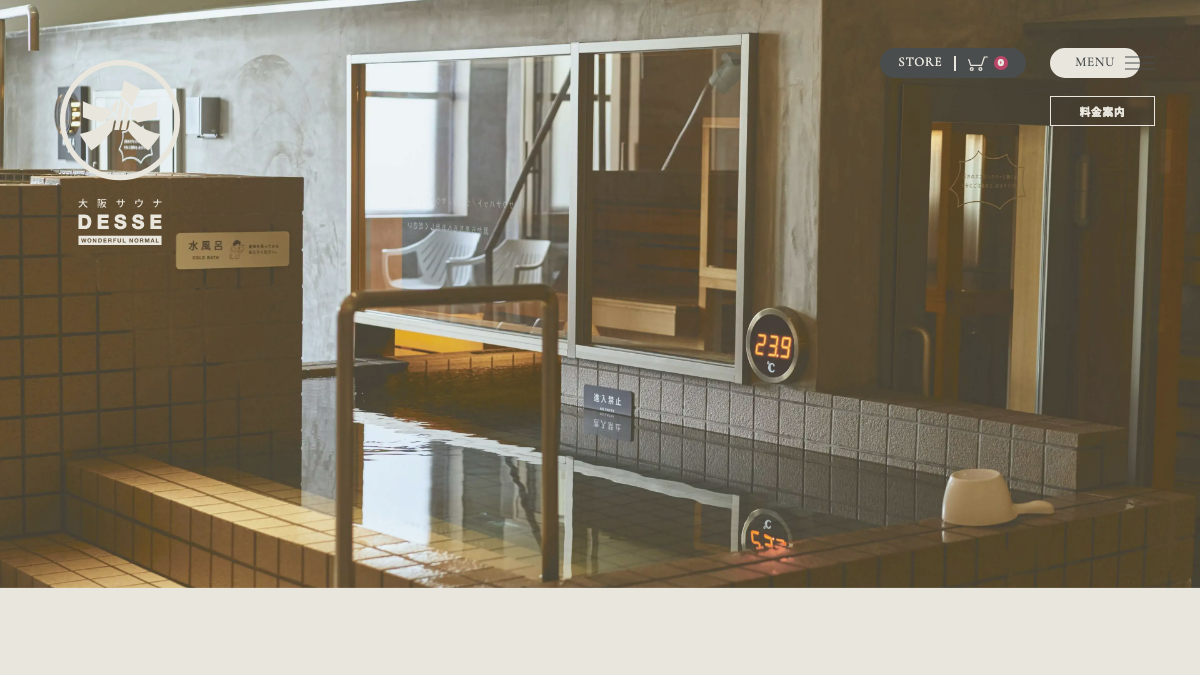
The cold bath is where DESSE shows its discipline. Many Japanese facilities run their mizuburo at 18–20°C, which is refreshing but doesn't trigger the full totonou cascade. DESSE holds theirs in the 14–16°C range—cold enough to do real work on your nervous system, not so cold that it becomes a macho endurance test. The bath is deep enough to submerge up to the shoulders, which is the correct depth.
The gaikiyoku (outdoor air-bath) space is the quiet star of the whole facility. A thoughtfully landscaped semi-outdoor area with reclining chairs, actual airflow, and just enough view of the sky to remind you that you are in a dense urban neighborhood. After a proper hot-cold round, sitting here with your eyes closed for ten minutes is exactly what sauna culture was invented for.
Facilities, Amenities, and Food
Beyond the bathing floors, DESSE has put real thought into the between-sets experience. The mixed-gender lounge has a small café-bar serving seasonal soft drinks, craft beer from Osaka microbreweries, and a short menu of light food—curry, onigiri, seasonal fruit plates—designed specifically to work as sauna fuel. Nothing heavy enough to wreck your next round, nothing so light that you crash.
All essential amenities are included in the entry fee: sauna wear, towels (both the small face towel and the large body towel), shampoo and body wash at the showers, toothbrush, hair tie, hair dryers in the locker room. You really do not need to bring anything except yourself, your wallet, and your phone (which stays in the locker).
There is also a small shop selling sauna-related merchandise: branded T-shirts, the house-scent aroma water used in the aufguss, and a few books. Worth a browse if you want to take something home.
How to Book and What It Costs
Pricing is tiered by time of day and day of week. The standard 120-minute slot runs ¥3,500–¥4,500 — generous enough for three full rounds plus lounge time. Premium slots sell out fastest; weekday mornings are the cheapest and the quietest, and our recommendation for foreign visitors:
- Weekday morning — Price: Lowest end of range · Crowd: Quietest · Recommended for: Foreign visitors, first-timers
- Weekday afternoon — Price: Mid-range · Crowd: Light · Recommended for: Solo totonou sessions
- Weekday evening — Price: Mid-to-high · Crowd: Moderate · Recommended for: After-work locals
- Weekend day — Price: Mid-to-high · Crowd: Busy · Recommended for: Couples, groups
- Friday/Saturday evening — Price: Top of range · Crowd: Sells out · Recommended for: Avoid on first visit
Reservations are made through the DESSE website, which has an English version. You pick a 2-hour slot, pay in advance by card, and get a QR code for entry. Walk-ins are technically possible but frequently turned away when the facility is near capacity, which is often. If you are in Osaka for a limited time, reserve.
Tattoo policy: Conditional. DESSE handles tattoos through two separate paths:
- Tattoo Days in the public areas. Wednesday, Thursday, Friday, and Saturday are designated Tattoo Days, when guests with tattoos are welcomed in the standard public sauna floors. On these days, no cover-up is required.
- Knot Sauna (private rental, any day). The Knot Sauna is a fully private suite available on advance reservation. Because no other guests share the room, tattoos are permitted regardless of the day of the week (¥20,000 / 120 min for 1–6 people, with a small per-person surcharge for groups of 5+).
Sundays, Mondays, and Tuesdays in the public areas do not accept tattooed guests. Please note that on non-Tattoo Days, the public floors cannot admit guests with tattoos — please be advised. Always check the official DESSE schedule before booking, as exceptions occasionally apply. For travelers who'd rather avoid the day-of-week juggling entirely, our list of tattoo-friendly onsen and bathhouses across Osaka covers smaller facilities with simpler entry rules.
Access and Area Tips
DESSE is about a 3-minute walk from Shinsaibashi (心斎橋) Station on the Midosuji Line—the main north-south subway artery in Osaka. From Namba (難波) and its surrounding hidden-gem cafés and bars, it's a 10-minute walk or one stop on the subway. From Umeda (梅田), it's about 8 minutes by subway.
The surrounding neighborhood is one of the densest shopping and dining zones in the city. Amerika-mura (アメリカ村) is five minutes west for vintage clothes and youth fashion. Shinsaibashi-suji (心斎橋筋), the covered shopping arcade, runs directly south toward Dotonbori. If you're pairing DESSE with dinner, there is no shortage of options—a properly cold beer and a bowl of ramen immediately after a totonou session is one of the small genuine luxuries of the city.
Pro Tip: DESSE is a perfect mid-afternoon stop when the heat of an Osaka summer day has made walking around Namba unpleasant. Book a 2 PM slot, do three rounds, emerge at 4 PM with a reset nervous system and an appetite, and go eat.
Website: https://desse.osaka/
FAQ: DESSE Questions From Foreign Visitors
Is there English-speaking staff? Basic English at the reception and locker room attendants. Enough to handle check-in, locker assignment, and explaining aufguss schedules. The website has an English page and the QR-code entry system makes the actual arrival straightforward.
Can I enter if I have tattoos? Yes — through one of two paths. The public sauna floors welcome tattooed guests on Tattoo Days (Wednesday through Saturday); cover-up is not required. Outside those days (Sunday, Monday, Tuesday), the only option is to book the private Knot Sauna — a fully private suite where the tattoo policy doesn't matter because you've reserved the room for your group. Always check the official schedule before booking.
Can I go if I've never been to a Japanese sauna before? DESSE is actually the single best facility in Osaka for first-timers who want the real thing. The staff is used to foreign guests, the schedule is clearly posted, and the design of the facility itself does a lot of the teaching—you can see the flow of how people move between rooms and just follow along.
Can my partner and I go together? You'll split up for the actual bathing floors (gender-segregated) but you can meet in the mixed-gender lounge between sets in provided sauna wear. Many couples do exactly this.
Can I use it just as a shower? No, DESSE is a full sauna session facility with a time-based entry fee. For shower-only access, any neighborhood sento in Osaka will serve you for ¥500.
Is photography allowed? No, not in any of the bathing floors or even the mixed-gender lounge. This is enforced. The brand relies heavily on Instagram, but those photos are all shot during closed-facility photo shoots, not by guests.
What should I wear? To enter the facility: whatever you normally wear. For the bathing floors: nothing (standard Japanese nudity rule). For the mixed-gender lounge: the provided sauna wear (a light T-shirt and shorts), included in the entry fee.
How DESSE Compares to Osaka's Other Major Saunas
If you're not sure DESSE is the right fit, here's how it stacks up against the other three flagship sauna experiences in the city:
- DESSE (Shinsaibashi) — *you are here* — Vibe: Premium, design-driven · Price: ¥3,500–¥4,500 · Tattoo: Conditional (Knot Sauna, Tattoo Days) · Best for: Sauna craft enthusiasts, polished first-timer
- [Spa World (Shinsekai)](/articles/spa-world-osaka-guide/) — Vibe: Populist, world-tour theme park · Price: ¥1,500–¥2,700 · Tattoo: Not allowed (any size, even stickers) · Best for: Families, budget travelers without tattoos
- [Solaniwa Onsen (Bay Area)](/articles/solaniwa-onsen-osaka/) — Vibe: Edo-themed garden, scenic · Price: ¥2,500–¥3,400 · Tattoo: Conditional (facility's stickers required) · Best for: Couples, USJ / Kaiyukan day-trip pairing
- [Grand Chateau (Kyobashi)](/articles/grand-chateau-kyobashi-sauna/) — Vibe: Showa retro, men-only · Price: ¥900–¥1,800 · Tattoo: No published policy — call ahead · Best for: Repeat visitors chasing authentic texture
For the full lineup including private-suite and neighborhood-sento options, see our Osaka Sauna Guide for Foreigners.
Final Thoughts: Who DESSE Is Really For
DESSE is the sauna we recommend to foreigners who want to understand what the current Japanese sauna boom is actually about. It's not the cheapest option in Osaka (that's Spa World), not the most scenic (that's Solaniwa), not the most distinctive (that's Grand Chateau Kyobashi)—but it's the most complete expression of where the culture currently sits. A designed space that takes the craft seriously, runs on a schedule, and treats foreign guests like adults who are perfectly capable of figuring it out once they're given the basics.
If you're a sauna enthusiast from Finland, Germany, Korea, or Australia, this is the place to see how Japan has put its own spin on the form. If you're a traveler who has never done a naked public bathing session in your life, DESSE is also, slightly counterintuitively, the gentlest possible introduction—because the polish of the environment takes care of most of the first-timer anxiety for you.
Compare DESSE with the rest of Osaka's sauna lineup in our full Osaka Sauna Guide for Foreigners. For a completely different kind of Osaka bathing night—one involving a Showa-era cabaret tower and a sauna that hasn't been redesigned since 1983—see our guide to Grand Chateau Kyobashi.